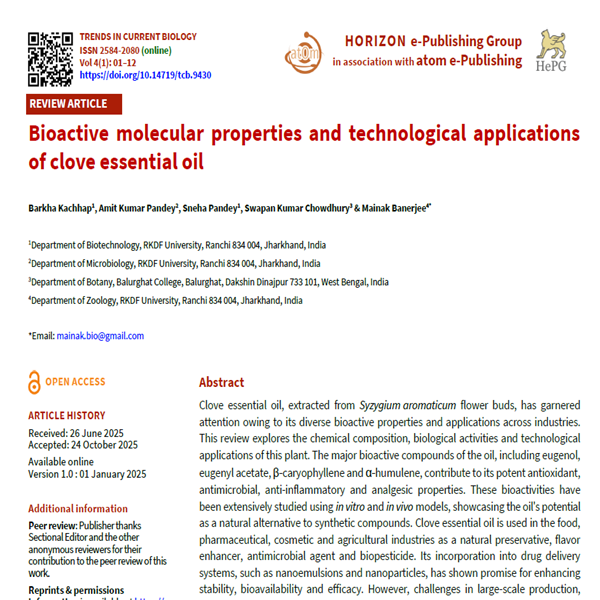
Bioactive molecular properties and technological applications of clove essential oil
DOI:
https://doi.org/10.14719/tcb.9430Keywords:
antimicrobial, biopesticide, clove essential oil, eugenol, food industry, pharmaceutical applicationsAbstract
Clove essential oil, extracted from Syzygium aromaticum flower buds, has garnered attention owing to its diverse bioactive properties and applications across industries. This review explores the chemical composition, biological activities and technological applications of this plant. The major bioactive compounds of the oil, including eugenol, eugenyl acetate, ?-caryophyllene and ?-humulene, contribute to its potent antioxidant, antimicrobial, anti-inflammatory and analgesic properties. These bioactivities have been extensively studied using in vitro and in vivo models, showcasing the oil's potential as a natural alternative to synthetic compounds. Clove essential oil is used in the food, pharmaceutical, cosmetic and agricultural industries as a natural preservative, flavor enhancer, antimicrobial agent and biopesticide. Its incorporation into drug delivery systems, such as nanoemulsions and nanoparticles, has shown promise for enhancing stability, bioavailability and efficacy. However, challenges in large-scale production, standardization of extraction methods, stability issues and environmental concerns need to be addressed. This review also discusses the toxicological profile and regulatory aspects of this oil, emphasizing safety and quality control. Future research directions include exploring the synergistic effects of other natural compounds, developing personalized medicine applications and optimizing sustainable production practices. The global market for clove essential oil is influenced by trends in the spice industry and the demand for organic products. Its cost-effectiveness compared to synthetic alternatives and potential for developing value-added products present significant economic opportunities.
Downloads
References
Haro-González JN, Espinosa-Andrews H, Martínez-Velázquez M, Castillo-Herrera GA. Clove essential oil (Syzygium aromaticum L. Myrtaceae): extraction, chemical composition, food applications and essential bioactivities for human health. Molecules. 2021;26(21):6387. https://doi.org/10.3390/molecules26216387
Haro-González JN, Espinosa-Andrews H, Martínez-Velázquez M, Castillo-Herrera GA. Clove essential oil (Syzygium aromaticum L. Myrtaceae): extraction, chemical composition, food applications and essential bioactivity for human health. Molecules. 2021;26(21):6387. https://doi.org/10.3390/molecules26216387
Alma MH, Erta? M, Kollmannsberger H, Nitz S. Chemical composition and content of essential oil from the bud of cultivated Turkish clove (Syzygium aromaticum L.). BioRes. 2007;2(2):265-69. https://doi.org/10.15376/biores.2.2.265-269
Prashar A, Locke IC, Evans CS. Cytotoxicity of clove (Syzygium aromaticum) oil and its major components to human skin cells. Cell Prolif. 2006;39(4):241-48. https://doi.org/10.1111/j.1365-2184.2006.00384.x
Núñez L, D'Aquino M. Microbicide activity of clove essential oil (Eugenia caryophyllata). Braz J Microbiol. 2012;43(4):1255-60. https://doi.org/10.1590/S1517-83822012000400003
Kouidhi B, Zmantar T, Bakhrouf A. Anticariogenic and cytotoxic activity of clove essential oil (Eugenia caryophyllata) against a large number of oral pathogens. Ann Microbiol. 2010;60(4):599-604. https://doi.org/10.1007/s13213-010-0092-6
Haro-González JN, Barbosa-Nuñez JA, Castillo-Herrera GA, Estarrón-Espinosa M, Herrera-Rodríguez SE, Espinosa-Andrews H, et al. Clove essential oil and its major component, eugenol: a comparative study of their in vitro antioxidant and anticancer properties. Nat Prod Res. 2024:1-8. https://doi.org/10.1080/14786419.2024.2404658
Kovács JK, Makszin L, Böszörményi A, Pápai Z, Horváth G, Ábrahám H, et al. Antimicrobial and virulence-modulating effects of clove essential oil on the foodborne pathogen Campylobacter jejuni. Appl Environ Microbiol. 2016;82(20):6158-66. https://doi.org/10.1128/AEM.01221-16
Farag RS, Badei AZMA, El Baroty GSA. Influence of thyme and clove essential oils on cottonseed oil oxidation. J Am Oil Chem Soc. 1989;66(6). https://doi.org/10.1007/BF02653671
Moemenbellah-Fard MD, Osanloo M, Ghanbariasad A, Abdollahi A. Antibacterial and leishmanicidal activities of Syzygium aromaticum essential oil versus its major ingredient, eugenol. Flavour Fragr J. 2020;35(5):534-40. https://doi.org/10.1002/ffj.3595
Ferreira FM, Vilela FMP, Amaral MPH, Novato TLP, Monteiro CMO, Delmonte CC, et al. Acaricidal activity of essential oil of Syzygium aromaticum, hydrolate and eugenol formulated or free on larvae and engorged females of Rhipicephalus microplus. Med Vet Entomol. 2017;32(1):41-7. https://doi.org/10.1111/mve.12259
Liñán-Atero R, Aghababaei F, García SR, Hasiri Z, Ziogkas D, Moreno A, et al. Clove essential oil: chemical profile, biological activities, encapsulation strategies and food applications. Antioxidants. 2024;13(4):488. https://doi.org/10.3390/antiox13040488
Echeverría I, Montero MP, López-Caballero ME, Mauri AN, Gómez-Guillén MC. Structure, functionality and active release of nanoclay-soy protein films affected by clove essential oil. Food Bioprocess Technol. 2016;9(11):1937-50. https://doi.org/10.1007/s11947-016-1777-z
Chaieb K, Rouabhia M, Mahdouani K, Hajlaoui H, Bakhrouf A, Zmantar T, et al. The chemical composition and biological activity of clove essential oil, Eugenia caryophyllata (Syzygium aromaticum L. Myrtaceae): a short review. Phytother Res. 2007;21(6):501-06. https://doi.org/10.1002/ptr.2124
Pilong P, Mishra DK, Siripatrawan U, Chuesiang P. Characteristics and antimicrobial activity of microfluidized clove essential oil nanoemulsion optimized using response surface methodology. Food Process Preserv. 2022;46(12). https://doi.org/10.1111/jfpp.16886
Kaur K, Kaushal S, Rani R. Chemical composition, antioxidant and antifungal potential of clove (Syzygium aromaticum) essential oil, its major compound and its derivatives. J Essent Oil Bear Plants. 2019;22(5):1195-1217. https://doi.org/10.1080/0972060X.2019.1688689
Das M, Saha AK, Guha C, Singh M, Roy S. In vitro evaluation of antioxidant and antibacterial properties of supercritical CO? extracted essential oil from clove bud (Syzygium aromaticum). J Plant Biochem Biotechnol. 2020;30(2):387-91. https://doi.org/10.1007/s13562-020-00566-9
Al Bayati MHM, Cengiz MF, Kiti? YE, Ç?nar O. Comparison of antimicrobial activities of oregano, lavender, sage, anise and clove extracts obtained by supercritical fluid carbon dioxide extraction and essential oils obtained by hydrodistillation. J Essent Oil Res. 2024:258-70. https://doi.org/10.1080/10412905.2024.2332940
Vargas Jentzsch P, Gualpa F, Ciobot? V, Ramos LA. Adulteration of clove essential oil: detection using a handheld Raman spectrometer. Flavour Fragr J. 2017;33(2):184-90. https://doi.org/10.1002/ffj.3438
Putra NR, Rizkiyah DN, Che Yunus MA, Kusuma HS, Darmokoesoemo H. Mapping the landscape of clove oil as essential oil for health and wellness: a bibliometric review of advances, challenges and future directions. J Essent Oil Bear Plants. 2024;27(2):300-26. https://doi.org/10.1080/0972060X.2024.2325099
Selles SMA, Kouidri M, Belhamiti BT, Ait Amrane A. Chemical composition, in-vitro antibacterial and antioxidant activities of Syzygium aromaticum essential oil. Food Measure. 2020;14(4):2352-58. https://doi.org/10.1007/s11694-020-00482-5
Chaieb K, Bakhrouf A, Hajlaoui H, Zmantar T, Abdelly C, Ksouri R, et al. Antioxidant properties of the essential oil of Eugenia caryophyllata and its antifungal activity against a large number of clinical Candida species. Mycoses. 2007;50(5):403-06. https://doi.org/10.1111/j.1439-0507.2007.01391.x
Issac A, Kuttan R, Gopakumar G, Maliakel B, Krishnakumar IM. Safety and anti-ulcerogenic activity of a novel polyphenol-rich extract of clove buds (Syzygium aromaticum L). Food Funct. 2015;6(3):842-52. https://doi.org/10.1039/C4FO00711E
Chen X, Yan F, Zhao G, Jiang H, Dang Y, Tian S, et al. Antioxidant activities of essential oils and their major components in scavenging free radicals, inhibiting lipid oxidation and reducing cellular oxidative stress. Molecules. 2023;28(11):4559. https://doi.org/10.3390/molecules28114559
Purkait S, Chattopadhyay RR, Bhattacharya A, Bag A. Synergistic antibacterial, antifungal and antioxidant efficacy of cinnamon and clove essential oils in combination. Arch Microbiol. 2020;202(6):1439-48. https://doi.org/10.1007/s00203-020-01858-3
Liu Q, Zhao C-N, Tang G-Y, Li H-B, Li Y, Meng X. Antibacterial and antifungal activities of spices. Int J Mol Sci. 2017;18(6):1283. https://doi.org/10.3390/ijms18061283
Kie?tyka-Dadasiewicz A, Jab?o?ska-Trypu? A, Esteban J. Antiviral, antibacterial, antifungal and anticancer activity of plant materials derived from Cymbopogon citratus (DC.) Stapf species. Pharmaceutics. 2024;17(6):705. https://doi.org/10.3390/ph17060705
Joshi B, Parajuli N, Luyten W, Jouneghani R-S, Panda S-K, Leyssen P, et al. Antibacterial, antifungal, antiviral and anthelmintic activities of medicinal plants of Nepal selected based on ethnobotanical evidence. Evid Based Complement Altern Med. 2020;2020:1-14. https://doi.org/10.1155/2020/1043471
Reichling J. Antiviral and virucidal properties of essential oils and isolated compounds - a scientific approach. Planta Med. 2021;88(8):587-603. https://doi.org/10.1055/a-1382-2898
Bachiega TF, Sforcin JM, Bastos JK, de Sousa J-P B. Clove and eugenol in non-cytotoxic concentrations exert immunomodulatory/anti-inflammatory action on cytokine production by murine macrophages. J Pharm Pharmacol. 2012;64(4):610-16. https://doi.org/10.1111/j.2042-7158.2011.01440.x
Esmaeili F, Zahmatkeshan M, Yousefpoor Y, Alipanah H, Safari E, Osanloo M. Anti-inflammatory and anti-nociceptive effects of cinnamon and clove essential oils nanogels: an in vivo study. BMC Complement Med Ther. 2022;22(1). https://doi.org/10.1186/s12906-022-03619-9
Elbestawy M-K M, El-Sherbiny G M, Moghannem S-A. Antibacterial, antibiofilm and anti-inflammatory activities of eugenol clove essential oil against resistant Helicobacter pylori. Molecules. 2023;28(6):2448. https://doi.org/10.3390/molecules28062448
Aman R M, Abu Hashim I I, Meshali M M. Novel clove essential oil nanoemulgel tailored by Taguchi's model and scaffold-based nanofibers: phytopharmaceuticals with promising potential as cyclooxygenase-2 inhibitors in external inflammation. Int J Nanomedicine. 2020;15:2171-2195. https://doi.org/10.2147/IJN.S246601
Khalilzadeh E, Hazrati R, Saiah G V. Effects of topical and systemic administration of Eugenia caryophyllata buds essential oil on corneal anesthesia and analgesia. Res Pharm Sci. 2016;11(4). https://doi.org/10.4103/1735-5362.189297
Taher Y A, Samud A M, El-Taher F E, Ben-Hussin G, Elmezogi J S, Al-Mehdawi B F, et al. Experimental evaluation of anti-inflammatory, antinociceptive and antipyretic activities of clove oil in mice. Libyan J Med. 2015;10(1):28685. https://doi.org/10.3402/ljm.v10.28685
Abdou A, Jamaleddine J, Elmakssoudi A, El Amrani A, Dakir M. Recent advances in chemical reactivity and biological activities of eugenol derivatives. Med Chem Res. 2021;30(5):1011-30. https://doi.org/10.1007/s00044-021-02712-x
Hikal W M, Tkachenko K G, Sany H, Baeshen R S, Said-Al Ahl H A H, Sabra A S, et al. Chemical composition and biological significance of thymol as antiparasitic. OJE. 2021;11(3):240-66. https://doi.org/10.4236/oje.2021.113018
Das S, Singh V K, Dwivedy A K, Chaudhari A K, Dubey N K. Insecticidal and fungicidal efficacy of essential oils and nano-encapsulation approaches for the development of next-generation eco-friendly green preservatives for management of stored food commodities: an overview. Int J Pest Manag. 2021;70(3):235-66. https://doi.org/10.1080/09670874.2021.1969473
Hu Q, Wei S, Zhou M. Progress on the antimicrobial activity research of clove oil and eugenol in the food antisepsis field. J Food Sci. 2018;83(6):1476-83. https://doi.org/10.1111/1750-3841.14180
Kumar Pandey V, Pandiselvam R, Rusu A V, Singh R, Shams R, Dar A H, et al. A comprehensive review on clove (Caryophyllus aromaticus L.) essential oil and its significance in the formulation of edible coatings for potential food applications. Front Nutr; 2022. https://doi.org/10.3389/fnut.2022.987674
Haro-González J N, Schlienger De Alba B N, Espinosa-Andrews H, Martínez-Velázquez M, Castillo-Herrera G A. Optimization of clove oil nanoemulsions: evaluation of antioxidant, antimicrobial and anticancer properties. Colloids Interfaces. 2023;7(4):64. https://doi.org/10.3390/colloids7040064
De Meneses A C, Sayer C, Araújo P H H, de Oliveira D, Puton B M S, Cansian R L. Production of clove oil nanoemulsion with rapid and enhanced antimicrobial activity against gram-positive and gram-negative bacteria. J Food Process Eng. 2019;42(6). https://doi.org/10.1111/jfpe.13209
Anwer M K, Ibnouf E O, Jamil S, Shakeel F. Enhanced antibacterial effects of clove essential oil by nanoemulsion. J Oleo Sci. 2014;63(4):347-54. https://doi.org/10.5650/jos.ess13213
Thakur D, Nanda R, Puri A, Kaur G. Therapeutic potential of essential oil-based microemulsions: reviewing state-of-the-art. Curr Drug Deliv. 2021;18(9):1218-33. https://doi.org/10.2174/1567201818666210217161240
Çetin Babaoglu H, Bayrak A, Özdemir N, Ozgun N. Encapsulation of clove essential oil in hydroxypropyl beta-cyclodextrin for characterization, controlled release and antioxidant activity. J Food Process Preserv. 2017;41(5):e13202. https://doi.org/10.1111/jfpp.13202
Haro-González J N, Martínez-Velázquez M, Castillo-Herrera G A, Espinosa-Andrews H. Clove essential oil nanoemulsions: development, physical characterization and anticancer activity evaluation. J Dispersion Sci Technol. 2024;46(5):842-50. https://doi.org/10.1080/01932691.2024.2302067
Viteri Jumbo L O, Haddi K, Faroni L R D, Heleno F F, Pinto F G, Oliveira E E. Toxicity to, oviposition and population growth impairments of Callosobruchus maculatus exposed to clove and cinnamon essential oils. PLoS ONE. 2018;13(11):e0207618. https://doi.org/10.1371/journal.pone.0207618
Alves de Figueiredo Sousa H, Egea M B, Macagnan D, Gonçalves de Oliveira Filho J, Peixoto J, Pires M, et al. Active film incorporated with clove essential oil on storage of banana varieties. NFS. 2019;49(5):911-24. https://doi.org/10.1108/NFS-09-2018-0262
Vasile C, Mitelu? A, Stoleru E, Brebu M, Khan W, Pamfil D, et al. Comparative analysis of the composition and active property evaluation of certain essential oils to assess their potential applications in active food packaging. Materials. 2017;10(1):45. https://doi.org/10.3390/ma10010045
Albuquerque R M, Vinhas G M, Sarubbo L A, Silva C J G, Meira H M, Almeida F C G, et al. Production of a bacterial cellulose/poly(3-hydroxybutyrate) blend activated with clove essential oil for food packaging. Polym Polym Compos. 2020;29(4):259-70. https://doi.org/10.1177/0967391120912098
Irimia A, Grigora? V C, Popescu C-M. Active cellulose-based food packaging and its use on foodstuff. Polymers. 2024;16(3):389. https://doi.org/10.3390/polym16030389
Cansian R L, Vanin A B, Orlando T, Cardoso R I, Paroul N, Oliveira D, et al. Toxicity of clove essential oil and its ester eugenyl acetate against Artemia salina. Braz J Biol. 2017;77(1):155-61. https://doi.org/10.1590/1519-6984.12215
Aggarwal M L, Chacko K M, Kuruvilla B T. Systematic and comprehensive investigation of the toxicity of curcuminoid-essential oil complex: a bioavailable turmeric formulation. Mol Med Rep. 2015;13(1):592-604. https://doi.org/10.3892/mmr.2015.4579
Santin J R, Bastos J K, De Andrade S F, De Souza J P, Tilia C, Lemos M, et al. Gastroprotective activity of essential oil of Syzygium aromaticum and its major component eugenol in different animal models. Naunyn-Schmied Arch Pharmacol. 2010;383(2):149-58. https://doi.org/10.1007/s00210-010-0582-x
Achagar R, Touzani R, Abdou A, Boujdi K, Ait-Touchente Z, El Ati R, et al. A comprehensive review of essential oil-nanotechnology synergy for advanced dermocosmetic delivery. Cosmetics. 2024;11(2):48. https://doi.org/10.3390/cosmetics11020048
Maciel M V D O B, Machado M H, Teixeira G L, Noronha C M, Rosa C G D, Barreto P L M, et al. Syzygium aromaticum L. (Clove) essential oil as a reducing agent for the green synthesis of silver nanoparticles. OJAppS. 2019;9(2):45-54. https://doi.org/10.4236/ojapps.2019.92005
Danthu P, Fawbush F, Simanjuntak R, Razafimamonjison G, Penot E, Jahiel M, et al. The clove tree and its products (clove bud, clove oil, eugenol): prosperous today but what of tomorrow's restrictions? Fruits. 2020;75(5):224-42. https://doi.org/10.17660/th2020/75.5.5
Muturi E J, Ramirez J L, Bowman M J, Doll K M. Combined toxicity of three essential oils against Aedes aegypti (Diptera: Culicidae) larvae. J Med Entomol. 2017;54(6):1684-91. https://doi.org/10.1093/jme/tjx168
Downloads
Published
Issue
Section
License
Copyright (c) 2026 Barkha Kachhap, Amit Kumar Pandey, Sneha Pandey, Swapan Kumar Chowdhury, Mainak Banerjee

This work is licensed under a Creative Commons Attribution 4.0 International License.